The CMS Case: Why the Air Force's Digital Infrastructure Demands a Laravel Platform
A comprehensive analysis of enterprise-grade content management, security, and scalability. Discover why migrating from legacy systems like WordPress to a robust Laravel framework is a strategic imperative for high-stakes environments.
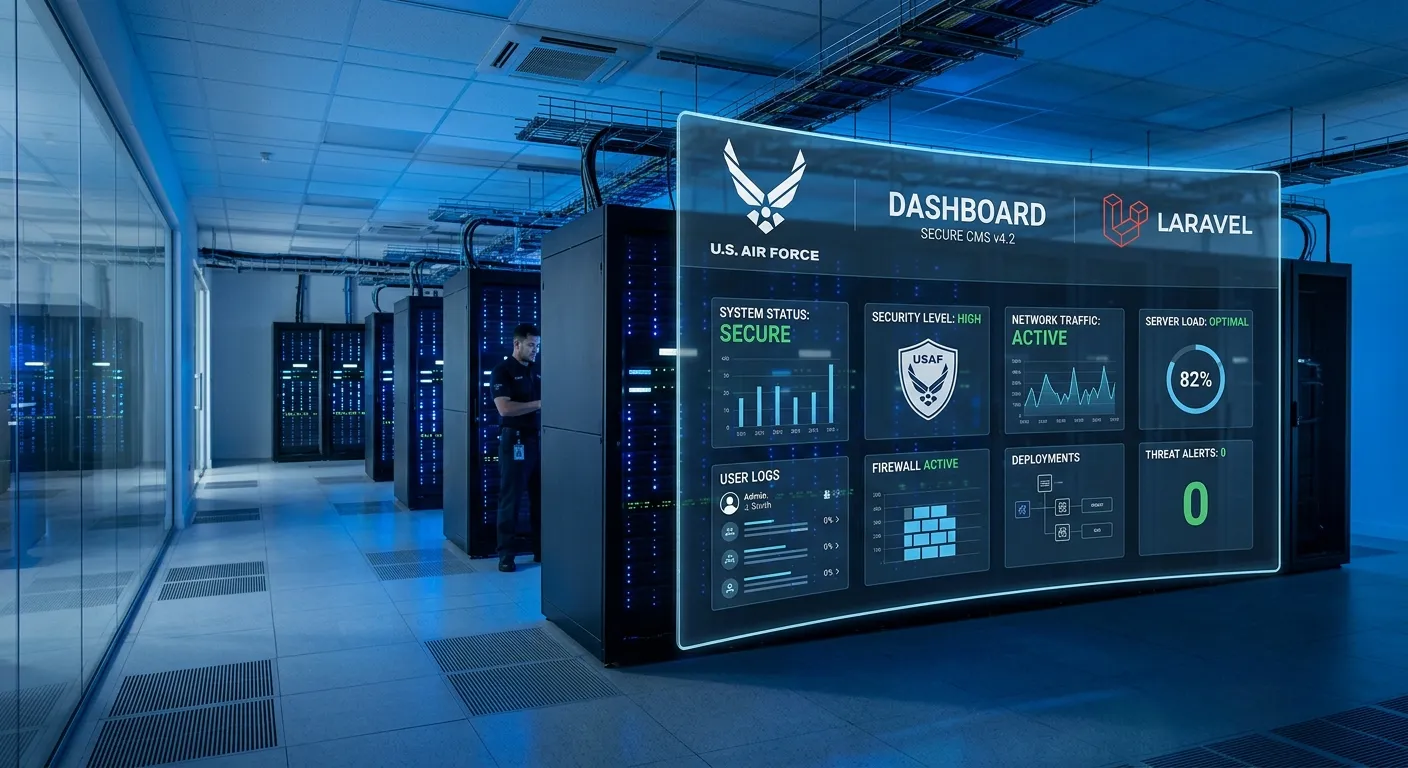
Strategic CMS Overview: A Multi-Dimensional Analysis
In the context of a Cms Case Air Force digital transformation, the choice of a Content Management System transcends basic website management. It becomes a cornerstone of operational security, information dissemination, and command communication. Legacy systems, often built on ubiquitous platforms like WordPress, present significant vulnerabilities and scalability challenges when subjected to the rigorous demands of military-grade operations. The strategic shift involves evaluating platforms not just for their ease of use, but for their architectural integrity, customizability, and ability to integrate with complex, secure networks.
This analysis draws parallels with enterprise migrations seen in other critical sectors, such as the technological innovations detailed in our analysis of GE Germany's advancements in aviation and healthcare. The core requirement is a platform that offers the familiarity of a CMS with the power of a full-stack framework—a need perfectly addressed by modern Laravel-based solutions that provide a WordPress-like interface built on Laravel's robust architecture.
Critical CMS Advantages for High-Stakes Environments
The following features are not mere conveniences; they are operational requirements for managing digital assets in a secure, scalable, and efficient manner.
Architectural Security & Compliance
Laravel's built-in security features, such as hashed passwords, encrypted sessions, and SQL injection prevention, provide a hardened base. This is essential for meeting strict compliance standards, reducing the reliance on vulnerable third-party plugins that are commonplace in typical WordPress setups.
Unmatched Performance at Scale
Laravel's efficient code execution, coupled with robust caching mechanisms (Redis, Memcached out-of-the-box), delivers page load times that dwarf traditional CMS platforms. This ensures rapid information retrieval and dissemination, even during high-traffic events, a key factor in any Cms Case Air Force communication strategy.
Seamless, Automated Migration
The fear of data loss during a platform transition is eliminated with automated migration tools. These systems handle content, users, media, and crucially, SEO metadata, ensuring a Wordpress Backup is just a safety net, not a rollback plan. Learn about this process in our guide "Migrate WordPress To Laravel Effortlessly".
Granular Permission & Workflow Control
Define user roles with surgical precision—from public affairs editors to classified document administrators. Laravel's authorization gates and policies offer far more control than standard CMS roles, enabling complex approval chains and audit trails that are mandatory for sensitive content management.
API-First & Headless Ready Architecture
Modern digital ecosystems require content to be delivered across multiple channels: web, mobile apps, intranets, and digital displays. Laravel's inherent API support makes building a headless CMS straightforward, allowing the backend to serve as a centralized content hub for all front-end applications.
Ecosystem & Long-Term Viability
Investing in a platform backed by a strong developer community and commercial ecosystem ensures long-term support and innovation. Unlike niche CMS solutions, Laravel's growth trajectory guarantees access to cutting-edge packages and professional Laravel Custom Development Services. For a comparison, see our Laravel CMS Comparison.
From Strategy to Deployment: A Phased Approach
Executing a Cms Case Air Force level migration requires meticulous planning. A successful implementation follows a clear, phased methodology to mitigate risk and ensure alignment with operational goals.
- Audit & Analysis: Inventory all existing content, users, plugins, and custom functionality. Assess security vulnerabilities and performance bottlenecks in the current WordPress setup.
- Architecture Design: Define the new Laravel-based information architecture, user roles, permission matrix, and integration points with existing military networks and databases.
- Pilot Migration: Use an automated WordPress to Laravel Migration tool on a non-critical subdomain or section. Validate data integrity, user access, and functionality.
- Security Hardening: Implement framework-level security, configure firewalls, set up encrypted connections, and establish automated audit logging protocols.
- Staging & User Acceptance Testing (UAT): Deploy the fully migrated site to a staging environment. Conduct rigorous testing with actual content managers and stakeholders.
- Go-Live & Monitoring: Execute the final cutover, typically during low-traffic periods. Monitor performance and error logs closely, with a rollback plan anchored by a final verified Wordpress Backup.
Essential Tools & Resources
Building a modern CMS requires the right components. Waravel provides a cohesive suite that addresses these needs directly.
- Core Features That Set Waravel Apart – Understand the unique capabilities of a Laravel-powered CMS.
- Unlock The Power Of Laravel – A foundational guide to the framework's advantages for enterprise.
- Waravel Package Features – Explore the specific modules and tools available for extended functionality.
- Plugins – Discover officially maintained add-ons for SEO, analytics, security, and more.
Frequently Asked Questions: CMS for Critical Operations
Why is WordPress considered a risk for a high-security environment like the Air Force?
WordPress's immense popularity is also its Achilles' heel in security-focused contexts. Its vast plugin and theme ecosystem creates a large, constantly shifting attack surface. Zero-day vulnerabilities in core or popular plugins are common and widely exploited. Furthermore, its database structure and procedural codebase can make consistent security auditing and custom hardening more challenging compared to a modern MVC framework like Laravel, which enforces cleaner separation of concerns and offers robust, built-in security features.
While diligent maintenance and a strict Wordpress Backup regime can mitigate some risk, they address symptoms, not the architectural root cause. For mission-critical systems, the platform itself must be designed with security as a foundational principle.
Can a Laravel CMS be as user-friendly for content editors as WordPress?
Absolutely. Modern Laravel-based CMS solutions are built with the content editor experience as a priority. They often feature intuitive, WYSIWYG editors, drag-and-drop page builders, and media libraries that are functionally identical—or superior—to the WordPress admin experience. The key difference is that this user-friendly interface is powered by a far more robust and secure backend engine.
Solutions like Waravel are specifically designed to offer a familiar CMS alternative that minimizes retraining time for teams accustomed to WordPress, while unlocking the advanced capabilities of the Laravel framework for developers and system administrators.
How does migration handle complex custom post types and fields from WordPress?
Professional-grade migration tools map WordPress custom post types and Advanced Custom Fields (ACF) to equivalent structured data models in Laravel (typically Eloquent models with custom attributes or JSON fields). The process involves:
- Schema Analysis: The tool scans the WordPress database to identify all custom post types, taxonomies, and field configurations.
- Model Generation: Corresponding Laravel migration files and model classes are created to replicate the data structure.
- Data Transformation & Import: All data from the custom fields is extracted, transformed to fit the new schema, and imported into the Laravel database with preserved relationships.
- Validation: A post-migration script verifies record counts and spot-checks complex entries to ensure fidelity.
This automated process is far more reliable than manual migration and is a core feature of enterprise WordPress Tools designed for platform transitions.
What is the total cost of ownership (TCO) comparison between a WordPress and a Laravel CMS?
While the initial development cost for a custom Laravel CMS can be higher than installing a WordPress theme, the TCO over 3-5 years often favors Laravel for enterprise use.
- WordPress TCO Drivers: Recurring costs for security plugins, performance plugins, premium themes, and developer hours to fix compatibility issues and vulnerabilities. Potential costs from security breaches and downtime.
- Laravel CMS TCO Drivers: Higher initial development/integration cost. Lower ongoing maintenance due to built-in features, cleaner code requiring less bug-fixing, and significantly reduced security incident costs. Greater developer efficiency for adding new features.
For an organization where reliability and security are paramount—as in a Cms Case Air Force scenario—the reduced risk and operational friction of a well-architected Laravel system provides a superior long-term value proposition. Explore real-world outcomes in our Case Studies.
Ready to Fortify Your Digital Infrastructure?
Whether you're planning a strategic migration for a critical organization or seeking to build a more resilient digital platform from the ground up, the time to act is now. Don't let a legacy CMS be your organization's weakest link.
For more insights on building a powerful digital presence, explore our Strategic Brand Building Guide or review our Terms Of Service and Privacy Policy.