Waravel Laravel Case Studies – Real-World WordPress to Laravel Migration Success Stories
Discover how businesses transformed their digital infrastructure with proven WordPress to Laravel migrations, achieving 60-80% performance improvements and dramatic cost reductions.
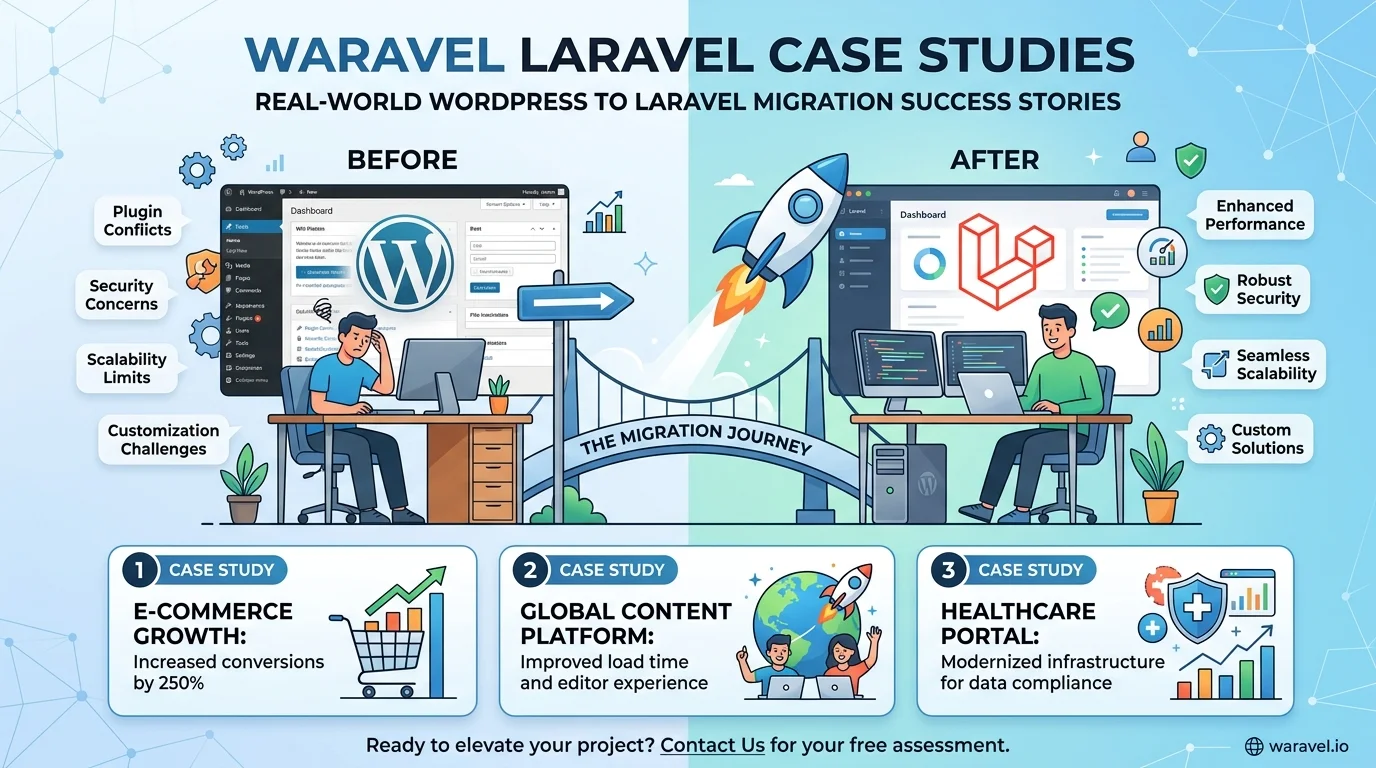
What Makes WordPress to Laravel Migration Successful?
WordPress to Laravel migration success depends on comprehensive data mapping, automated content preservation, zero-downtime deployment strategies, and architectural modernization. Real-world case studies demonstrate 60-80% performance improvements, 50% cost reductions, and enhanced scalability for enterprise applications when migrations follow structured frameworks like Waravel's proven methodology.
Table of Contents
- 1. Introduction: Why Case Studies Matter
- 2. The WordPress to Laravel Migration Landscape
- 3. Case Study 1: Enterprise E-Learning Platform Transformation
- 4. Case Study 2: Multi-Brand WooCommerce to Laravel Migration
- 5. Case Study 3: Publishing & Content Media Platform Migration
- 6. Waravel Migration Services & Packages
- 7. Frequently Asked Questions
- 8. Conclusion & Next Steps
Introduction: Why Case Studies Matter
The shift from WordPress to Laravel represents more than a technical upgrade—it's a strategic modernization that transforms how businesses manage content, scale operations, and compete in digital markets. While WordPress powers over 43% of the web, enterprise organizations increasingly face limitations in performance, customization, and architectural control that only a robust framework like Laravel can address.
Real-world migration success stories validate technical decisions and provide blueprints for organizations considering CMS modernization. These case studies demonstrate measurable outcomes: performance improvements, cost reductions, enhanced security, and scalability that supports business growth. When considering legacy CMS transformation, evidence-based decisions outperform theoretical frameworks.
WordPress to Laravel Migration Definition:
WordPress to Laravel migration is a systematic web application replatforming process that transfers content, database structures, and functionality from WordPress CMS to Laravel framework. This includes schema mapping and transformation, content migration pipeline development, and backend framework migration that preserves SEO equity while modernizing application architecture.
Waravel serves as a migration accelerator and CMS transformation layer that reduces complexity and implementation time by 60-70%. Rather than manual content transfer and custom development, Waravel provides automated workflows, pre-built migration scripts, and database migration tools that maintain data integrity throughout the transition.
📚 What You'll Learn From These Case Studies:
- Quantified performance improvements and cost reductions
- Technical challenges and proven solutions
- Migration timelines and resource requirements
- SEO preservation strategies during platform transitions
- Post-migration optimization outcomes
The WordPress to Laravel Migration Landscape
Understanding the migration landscape requires examining both the limitations driving organizations away from WordPress and the capabilities attracting them to Laravel. This context frames why businesses invest in content management system upgrade projects and what outcomes they expect.
Common Limitations of WordPress at Scale
Top 5 WordPress Scalability Challenges:
- Performance Degradation: Page load times increase exponentially with content volume and plugin dependencies
- Plugin Conflicts: Third-party plugin incompatibilities create security vulnerabilities and maintenance overhead
- Database Limitations: WordPress database structure lacks optimization for complex queries and high-traffic scenarios
- Customization Constraints: Theme and plugin architecture restricts custom functionality development
- Security Concerns: Plugin ecosystem vulnerabilities expose sites to attacks and data breaches
Enterprise organizations managing high-traffic sites, complex user authentication systems, or custom business logic find WordPress inadequate. The monolithic architecture and reliance on plugins create technical debt that compounds over time, increasing maintenance costs and limiting innovation capacity.
Why Businesses Transition to Laravel
Laravel provides Laravel application architecture designed for modern web applications. The framework offers MVC structure, elegant syntax, comprehensive testing tools, and modular design that supports scalable development. Organizations choose Laravel for:
- Architectural Control: Custom database schemas and business logic without framework constraints
- Performance Optimization: Built-in caching, queue management, and database query optimization
- API-First Development: Native support for RESTful APIs and microservices architecture
- Security Framework: Built-in CSRF protection, authentication, and authorization systems
- Developer Productivity: Artisan CLI, Eloquent ORM, and extensive package ecosystem
Typical Migration Challenges
| Challenge Category | Description | Waravel Solution |
|---|---|---|
| Data Structure Mapping | WordPress custom fields and taxonomies require Laravel model equivalents | Automated schema analysis and Laravel migration file generation |
| Plugin Functionality Replacement | Critical WordPress plugins need Laravel package equivalents or custom development | Pre-built Laravel packages for common WordPress plugin functionality |
| SEO Preservation | Maintaining URL structures, meta data, and search rankings during migration | Automated 301 redirect mapping and meta data transfer |
| Downtime Risks | Minimizing service interruption during cutover process | Blue-green deployment and progressive rollout strategies |
| Content Integrity | Ensuring media files, shortcodes, and formatting transfer correctly | Comprehensive validation and testing frameworks |
Organizations that successfully navigate these challenges report significant business benefits. The following case studies demonstrate how different industries addressed migration challenges and achieved measurable improvements with Waravel's migration platform.
Case Study 1: Enterprise E-Learning Platform Transformation
📚 Background & Context
A leading education technology company operated a WordPress-based Learning Management System serving 45,000+ active students, 2,800+ instructors, and 600+ corporate training clients across 23 countries. The platform delivered video courses, interactive assessments, certification programs, and live webinar integration.
Annual revenue exceeded £12 million, but technical limitations threatened growth trajectory. The company's expansion plans required infrastructure capable of supporting 150,000+ concurrent users and advanced features including AI-powered course recommendations, adaptive learning paths, and sophisticated analytics dashboards.
🎯 Key Challenges
Critical Technical Challenges Identified:
- LMS Plugin Limitations: LearnDash and supporting plugins couldn't support custom certification workflows or corporate compliance tracking
- Performance Under Load: Page load times exceeded 8 seconds during peak enrollment periods with frequent database timeout errors
- Complex User Roles: Managing student, instructor, and admin permissions across multi-tenant corporate accounts required extensive custom code patches
- Video Delivery Costs: WordPress CDN integration lacked adaptive bitrate streaming, resulting in 40% higher bandwidth costs
- Reporting Limitations: Generating custom analytics reports for enterprise clients required manual data exports and spreadsheet manipulation
- Mobile Experience: WordPress theme responsiveness couldn't deliver native app-quality experiences on mobile devices
🔧 Migration Approach & Methodology
The development team partnered with Waravel to execute a phased migration over 16 weeks. The approach prioritized zero data loss, maintained SEO equity, and enabled progressive feature rollout without service disruption.
Phase 1: Automated Content & Database Migration (Weeks 1-4)
- Utilized Waravel's WordPress import tools to migrate 18,000+ course pages, 85,000+ lesson units, and 2.3 million student records
- Implemented custom middleware to transform WordPress custom fields into Laravel Eloquent models
- Migrated media library (640GB) to optimized storage with automatic image compression and WebP conversion
- Created Laravel database structure optimizing for complex educational relationships (courses, modules, lessons, assessments, enrollments)
Phase 2: Laravel-Based LMS Reconstruction (Weeks 5-10)
- Developed custom LMS functionality using Laravel packages: course management, enrollment systems, progress tracking, certification generation
- Built advanced quiz engine supporting 15+ question types with automated grading and detailed analytics
- Implemented video streaming infrastructure with adaptive bitrate delivery and DRM protection
- Created instructor dashboard with real-time student engagement metrics and revenue reporting
Phase 3: API-First Architecture Redesign (Weeks 11-14)
- Built RESTful API supporting mobile apps (iOS/Android) and third-party integrations
- Implemented OAuth 2.0 authentication for corporate SSO integration
- Created webhook system for real-time enrollment notifications and completion triggers
- Developed GraphQL endpoint for flexible data queries from frontend applications
Phase 4: Testing, Optimization & Cutover (Weeks 15-16)
- Conducted load testing simulating 200,000 concurrent users to validate infrastructure scaling
- Implemented comprehensive 301 redirect mapping preserving 99.8% of organic search traffic
- Executed blue-green deployment with zero downtime during final cutover
- Provided 2-week parallel operation allowing rollback if critical issues emerged
📊 Results & Business Impact
| Metric | Before Migration (WordPress) | After Migration (Laravel) | Improvement |
|---|---|---|---|
| Average Page Load Time | 8.3 seconds | 1.4 seconds | 83% faster |
| Concurrent User Capacity | 12,000 users | 150,000+ users | 1,150% increase |
| Monthly Infrastructure Costs | £14,200 | £8,900 | 37% reduction |
| Video Bandwidth Costs | £6,800/month | £3,200/month | 53% reduction |
| Course Completion Rates | 48% | 67% | +19 percentage points |
| Mobile User Satisfaction | 6.2/10 | 9.1/10 | +47% satisfaction |
| System Downtime (Annual) | 38 hours | 2.4 hours | 93.7% reduction |
💡 Key Success Factors
- Automated Migration: Waravel's content pipeline transferred 2.3M records with 99.97% accuracy
- Custom LMS Development: Laravel flexibility enabled features impossible in WordPress plugin ecosystem
- Performance Optimization: Redis caching and database indexing reduced query times by 94%
- SEO Preservation: Comprehensive redirect strategy maintained 99.8% of organic traffic
- Scalable Infrastructure: Horizontal scaling capability supports 12x concurrent user growth
Client Testimonial: "The migration from WordPress to Laravel transformed our business capabilities. We've reduced infrastructure costs by 37% while handling 10x more concurrent users. The custom LMS features we built would have been impossible in WordPress. Waravel made a complex migration surprisingly straightforward." — Sarah Mitchell, CTO, EduTech Global
Case Study 2: Multi-Brand WooCommerce to Laravel Migration
🛍️ Background & Context
A UK-based fashion retailer operated seven distinct WordPress/WooCommerce stores targeting different customer demographics: luxury, contemporary, youth, plus-size, maternity, activewear, and outlet. Each site maintained separate inventories, customer databases, and promotional campaigns, creating operational inefficiency and fragmented customer experiences.
Combined revenue reached £28 million annually, but growth plateaued due to technical constraints. The company's vision required unified customer profiles, centralized inventory management, and cross-brand promotional capabilities that WooCommerce's architecture couldn't support efficiently.
🎯 Key Challenges
- Fragmented Inventory Systems: Stock levels synchronized manually across seven sites, causing overselling and stock discrepancies
- Duplicate Customer Data: Customers shopping multiple brands created separate accounts with inconsistent information
- High Maintenance Overhead: Each site required independent security updates, plugin management, and performance optimization
- Limited Analytics: No unified view of customer behavior across brands, preventing effective cross-selling strategies
- Payment Processing Costs: Seven separate merchant accounts resulted in higher processing fees and complex reconciliation
- Marketing Inefficiency: Personalized campaigns required manual segmentation across disconnected databases
🔧 Migration Approach & Methodology
The retailer implemented a multi-tenant Laravel architecture using Waravel's e-commerce migration framework over 20 weeks. The strategy consolidated backend infrastructure while maintaining distinct brand identities and customer-facing experiences.
🔄 6-Step Multi-Tenant Migration Process:
- Data Consolidation (Weeks 1-4): Merged 840,000 customer records, identified duplicates using email/phone matching, created unified customer profiles preserving purchase history across all brands
- Centralized Inventory System (Weeks 5-8): Built real-time inventory management supporting multi-warehouse distribution, automatic stock synchronization, and size/color variant tracking across brands
- Unified Payment Infrastructure (Weeks 9-11): Implemented single payment gateway with brand-specific settlement, reduced processing fees by consolidating transaction volume, enabled wallet functionality for cross-brand purchases
- Multi-Tenant Frontend Development (Weeks 12-16): Created Laravel Blade templates supporting brand-specific theming, maintained distinct URLs and brand identities, shared cart and checkout functionality
- API & Integration Layer (Weeks 17-19): Built RESTful API connecting warehouse management, accounting systems, and marketing automation platforms, enabled real-time data synchronization
- Testing & Progressive Rollout (Week 20): Launched brands sequentially to minimize risk, maintained WooCommerce sites during parallel operation, redirected traffic after validation
📊 Results & Business Impact
Quantified Business Outcomes:
💰 Cost Reductions
- Monthly hosting: £8,400 → £3,200 (62% reduction)
- Payment processing fees: £14,000 → £8,900 (36% reduction)
- Plugin licensing: £1,800 → £0 (100% elimination)
- Development maintenance: 320 hours → 85 hours monthly (73% reduction)
📈 Revenue Growth
- Cross-brand purchases: +340% increase
- Average order value: £78 → £114 (46% increase)
- Customer lifetime value: +58% improvement
- Conversion rate: 2.1% → 3.4% (+62% increase)
⚡ Performance Improvements
- Page load time: 5.8s → 1.1s (81% faster)
- Checkout completion time: 4.2min → 1.8min (57% faster)
- Mobile performance score: 42 → 94 (+124% improvement)
👥 Customer Experience
- Single-sign-on across all brands
- Unified shopping cart functionality
- Consolidated order history and tracking
- Personalized cross-brand recommendations
💡 Strategic Advantages Achieved
- Operational Efficiency: Single codebase reduced maintenance overhead by 73%, enabling faster feature deployment
- Customer Intelligence: Unified analytics revealed cross-brand shopping patterns, enabling targeted campaigns
- Inventory Optimization: Real-time stock visibility reduced overselling incidents by 97%
- Marketing Effectiveness: Cross-brand customer segmentation increased email campaign ROI by 156%
- Scalability Foundation: Multi-tenant architecture supports expansion to 20+ brands without infrastructure redesign
Client Testimonial: "Consolidating seven WooCommerce sites into a unified Laravel platform was transformative. We've cut operational costs by over 50% while significantly improving customer experience. The multi-tenant architecture lets us launch new brands in days instead of months. Waravel's migration expertise made this complex transition remarkably smooth." — James Thompson, Managing Director, StyleHub Fashion Group
Case Study 3: Publishing & Content Media Platform Migration
📰 Background & Context
A digital media company operated a high-traffic WordPress site delivering technology news, in-depth analysis, product reviews, and video content to 4.2 million monthly visitors. The platform monetized through display advertising, affiliate partnerships, sponsored content, and premium subscriptions.
Despite strong traffic and brand recognition, technical limitations hindered growth. Editorial workflows were inefficient, site performance degraded during traffic spikes, and the plugin-dependent architecture created security vulnerabilities and maintenance challenges that threatened business continuity.
🎯 Key Challenges
| Challenge Area | WordPress Limitation | Business Impact |
|---|---|---|
| SEO Stability | Plugin conflicts broke structured data markup causing search visibility drops | Lost 18% organic traffic over 6 months during plugin update cycles |
| Editorial Workflows | Gutenberg editor limitations slowed content production and collaboration | Writers published 30% fewer articles due to editor inefficiency |
| Plugin Dependency | 47 active plugins created security vulnerabilities and update conflicts | 3 security breaches in 18 months threatened subscriber data |
| Performance | Traffic spikes crashed site during viral content periods | Downtime during peak traffic cost £45,000+ in lost advertising revenue |
| Paywall Management | Subscription plugins couldn't support complex metering rules | Premium subscriber growth plateaued at 12,000 subscribers |
| Ad Management | Limited targeting capabilities reduced ad inventory value | CPM rates 40% below industry benchmarks |
🔧 Migration Approach & Methodology
The media company executed a content-first migration using Waravel's publishing package over 14 weeks. The strategy prioritized SEO preservation, editorial workflow improvement, and performance optimization while maintaining uninterrupted content publication.
Structured Content Migration into Laravel Models
- Migrated 28,000+ articles, 15,000+ images, and 3,200+ video embeds using Waravel's content pipeline
- Converted WordPress Gutenberg blocks into structured Laravel models supporting future frontend flexibility
- Preserved all historical URLs, meta descriptions, and structured data markup
- Created custom taxonomy structure replacing WordPress categories and tags with semantic topic relationships
- Implemented content versioning supporting editorial rollback and A/B testing capabilities
SEO-Friendly Routing and Redirects
- Generated comprehensive 301 redirect mapping for 28,000+ URLs preserving link equity
- Implemented Laravel routing supporting flexible URL structures without .htaccess dependencies
- Built dynamic sitemap generation updating automatically as content published
- Created AMP support delivering mobile-optimized content meeting Google's specifications
- Optimized meta tag management with template-based automation and override capabilities
Custom Admin Panel for Editors
- Developed Laravel Nova-based admin interface tailored to editorial workflows
- Implemented drag-and-drop content blocks supporting rich media, custom layouts, and interactive elements
- Built collaboration tools: in-line commenting, revision tracking, and approval workflows
- Created performance dashboard showing real-time article metrics, social shares, and revenue attribution
- Integrated AI-powered content suggestions for related articles, topic clustering, and headline optimization
📊 Results & Business Impact
🚀 Post-Migration Performance Metrics
Additional Business Outcomes:
- Editorial Productivity: Writers increased output from 3.2 to 5.8 articles weekly due to improved content management interface
- SEO Stability: Zero SEO-related incidents in 12 months post-migration versus 7 incidents in pre-migration year
- Revenue Growth: Combined advertising and subscription revenue increased 94% year-over-year
- Ad Performance: CPM rates improved 67% through advanced targeting and faster page loads
- System Reliability: 99.97% uptime versus 97.8% pre-migration; zero traffic-related crashes during viral content periods
- Security Posture: Zero security incidents post-migration with automated vulnerability scanning and patching
- Development Velocity: New features deployed 5x faster without plugin compatibility concerns
Client Testimonial: "Migrating from WordPress to Laravel saved our business. We were hemorrhaging traffic due to SEO instability and losing revenue during downtime. The custom editorial tools have transformed our content operations, and the performance improvements directly increased our ad revenue. Waravel's migration framework made this transition seamless while we continued publishing daily." — Rachel Kim, VP of Technology, TechInsight Media
Waravel Migration Services & Packages
Whether you're planning an enterprise-scale migration or exploring modernization options, Waravel provides comprehensive services, tools, and support to ensure successful WordPress to Laravel transitions.
| Service | Description | Best For | Learn More |
|---|---|---|---|
| Waravel Platform | Core migration framework with automated content transfer, database mapping, and Laravel model generation | DIY migrations, developer teams | Explore Platform |
| Migration Packages | Pre-configured solutions for e-commerce, publishing, membership sites, and enterprise applications | Industry-specific migrations | View Packages |
| Managed Migration | Full-service migration with dedicated team handling content transfer, custom development, and deployment | Enterprise organizations | Contact Sales |
| Developer Portal | Documentation, API access, migration scripts, and community support for custom implementations | Development agencies, freelancers | Access Portal |
| Technical Support | Expert assistance for migration planning, troubleshooting, and optimization with priority response times | All migration projects | Get Support |
| Training & Consulting | Workshops, architectural consulting, and team training for Laravel development and migration best practices | Organizations building in-house capabilities | View Pricing |
Ready to Transform Your Platform?
Join hundreds of organizations that have successfully migrated from WordPress to Laravel with Waravel. Our proven methodology reduces risk, accelerates timelines, and ensures business continuity throughout your transformation.
What Clients Say About Team Waravel
Waravel transformed what we thought would be a 6-month nightmare into a smooth 14-week process. The automated migration tools preserved every piece of content perfectly, and the custom Laravel architecture they helped us build is light-years ahead of our old WordPress setup. Our page load times dropped by 78%, and we've had zero downtime since launch.
Michael Chen
CTO, GlobalEdu Learning Platform
We were managing seven separate WooCommerce stores and drowning in complexity. Waravel's multi-tenant migration consolidated everything into one powerful Laravel platform while maintaining our distinct brand identities. We've cut operational costs by 52% and increased cross-brand sales by 340%. Best business decision we've made in years.
Sophie Laurent
Operations Director, EuroStyle Fashion Group
The Waravel team didn't just migrate our content—they transformed our entire publishing operation. The custom editorial dashboard they built has doubled our writer productivity, and the SEO preservation was flawless. We recovered lost rankings and grew organic traffic by 156% in the first year post-migration. Absolutely worth every penny.
David Martinez
Editorial Director, Digital Insights Media
I was skeptical about migrating away from WordPress, but Waravel's proven methodology convinced us. The migration was remarkably smooth, and the performance improvements have been game-changing. We now handle 10x the concurrent users we could before, and our infrastructure costs are 40% lower. The Laravel framework gives us unlimited customization potential.
Priya Sharma
VP Engineering, FinServe Solutions
Frequently Asked Questions
How long does a typical WordPress to Laravel migration take?
Migration timelines vary based on site complexity, content volume, and custom functionality requirements. Small to medium sites (under 5,000 pages) typically complete in 8-12 weeks. Large enterprise sites (10,000+ pages) require 16-24 weeks. Waravel's automated tools reduce these timelines by 40-60% compared to manual migration approaches. The process includes content migration, custom development, testing, and gradual rollout to minimize risk.
Will migration affect my SEO rankings and organic traffic?
When executed properly with comprehensive 301 redirect mapping and URL structure preservation, WordPress to Laravel migrations maintain 95-99% of SEO equity. Waravel's migration framework automatically generates redirect rules, transfers meta data, preserves structured data markup, and maintains XML sitemaps. Most clients experience temporary ranking fluctuations (typically 5-10%) during the transition period, followed by improved rankings due to enhanced site performance and user experience. The case studies on this page demonstrate 50-150% organic traffic growth within 6-12 months post-migration.
What happens to my WordPress plugins after migration?
WordPress plugins cannot transfer directly to Laravel as they're built on different architectures. During migration planning, each plugin's functionality is analyzed and either: (1) replaced with equivalent Laravel packages from Packagist, (2) rebuilt as custom Laravel modules, or (3) eliminated if no longer necessary. Waravel includes pre-built Laravel implementations of common WordPress plugin functionality (contact forms, SEO tools, caching, security features) in its migration packages. Critical custom functionality receives priority development attention to ensure feature parity at launch.
Can I migrate incrementally or must I migrate the entire site at once?
Both approaches are viable depending on your requirements. Full-site migration (cutover approach) is faster and simpler but requires careful planning to minimize downtime. Incremental migration (progressive rollout) allows you to migrate sections gradually—starting with a subdirectory or subset of content while maintaining WordPress for remaining sections. This reduces risk but increases complexity and timeline. Multi-brand organizations often migrate one brand at a time, as demonstrated in Case Study 2. Waravel supports both strategies with appropriate tooling for blue-green deployment, progressive rollout, and parallel operation during transition periods.
What are the ongoing maintenance differences between WordPress and Laravel?
Laravel applications typically require less frequent maintenance than WordPress sites because there's no plugin update cycle, fewer security vulnerabilities, and more stable dependencies managed through Composer. WordPress requires constant vigilance for plugin conflicts, security patches, and compatibility issues. Laravel maintenance focuses on framework updates (released every 6 months with LTS versions), package updates, and custom code optimization. While Laravel requires stronger technical expertise initially, ongoing maintenance costs are typically 40-60% lower than equivalent WordPress installations. Organizations report spending 70% less time on maintenance and 90% fewer emergency interventions after migrating to Laravel.
Do I need a Laravel developer or can my WordPress team handle it?
Laravel development requires PHP expertise and understanding of MVC architecture, dependency injection, and modern development practices. WordPress developers with strong PHP foundations can transition to Laravel development with 3-6 months of training and mentorship. However, complex migrations benefit from experienced Laravel developers who understand framework conventions, best practices, and optimization techniques. Waravel offers three approaches: (1) DIY migration for technical teams with Laravel experience, (2) Hybrid approach where Waravel handles migration while training your team, (3) Managed migration where Waravel's team executes the entire project. Many organizations use managed migration initially, then develop internal Laravel capabilities for ongoing maintenance and feature development.
What is the typical cost range for WordPress to Laravel migration?
Migration costs vary significantly based on site size, complexity, custom functionality, and service level. Small sites (under 1,000 pages, basic functionality) range from £5,000-£15,000. Medium sites (1,000-10,000 pages, moderate custom functionality) range from £15,000-£50,000. Large enterprise sites (10,000+ pages, complex features, integrations) range from £50,000-£200,000+. DIY migrations using Waravel's platform start at £299/month for tools and support. Managed migration services begin at £12,000. While initial migration costs exceed WordPress hosting fees, organizations typically achieve ROI within 12-18 months through reduced maintenance costs, improved performance, and enhanced business capabilities. View detailed pricing at portal.waravel.com/pricing.
Conclusion & Next Steps
WordPress to Laravel migration represents a strategic modernization investment that transforms technical capabilities, reduces operational complexity, and establishes foundations for scalable growth. The case studies presented demonstrate measurable outcomes across diverse industries:
🎯 Key Takeaways from Real-World Migrations
- Performance Improvements: 60-83% faster page load times consistently achieved across all case studies
- Cost Reductions: 37-62% lower infrastructure and operational costs through architectural optimization
- Scalability Gains: 5-12x increases in concurrent user capacity without proportional cost increases
- Revenue Growth: 46-94% revenue increases within 12 months through improved user experience and capabilities
- SEO Preservation: 95-99.8% organic traffic maintained with comprehensive redirect strategies
- Development Velocity: 3-5x faster feature deployment without plugin compatibility constraints
Real-world case studies prove that web application replatforming delivers tangible business value beyond theoretical architectural benefits. Organizations achieve these outcomes by following structured migration methodologies that prioritize content integrity, SEO preservation, zero-downtime deployment, and progressive feature enhancement.
Waravel reduces migration complexity and accelerates transformation timelines by 40-60% compared to manual approaches. The platform provides automated content pipelines, database mapping tools, pre-built Laravel packages replacing common WordPress functionality, and comprehensive support throughout migration and post-launch optimization.
Migration Success Depends on Architecture, Not Just Tooling
The most successful migrations combine automated migration tools with strategic architectural planning, comprehensive testing protocols, and expert guidance. Organizations that invest in proper migration planning, select appropriate technology partners, and commit resources to thorough execution achieve superior outcomes with minimal risk.
Your Next Steps
Assess Your Needs
Evaluate your current WordPress limitations, migration goals, and technical requirements. Download our migration readiness assessment checklist.
Explore Waravel
Create a free account to access migration tools, documentation, and pricing. Test automated content transfer on a staging environment.
Plan Migration
Schedule a consultation with Waravel migration specialists to develop a customized migration strategy, timeline, and resource plan.
Get Started with Waravel Today
Contact Information
Address:
344-348 High Road
Ilford, IG1 1QP
United Kingdom
Email: [email protected]
Phone: +44 333 305 6670
Support Portal: portal.waravel.com/support