Engineer Superior Digital Experiences with a Robust Laravel Backend
Discover how a powerful Laravel backend architecture empowers developers to build scalable, secure, and high-performance applications that drive business growth.
Why Laravel Dominates Modern Backend Development
Laravel has evolved from a simple PHP framework into a comprehensive ecosystem for building everything from monolithic enterprise applications to microservices APIs. Its elegant syntax, coupled with a powerful suite of built-in tools, allows teams to ship features faster while maintaining exceptional code quality. A well-architected Laravel backend serves as the silent engine of your digital presence, directly impacting user retention, SEO performance, and operational efficiency. For organizations looking to modernize, platforms like Waravel provide the bridge to migrate WordPress to Laravel effortlessly, unlocking this power without a disruptive rebuild.
MVC & Beyond: Crafting Maintainable Code
Laravel's adherence to the Model-View-Controller (MVC) pattern provides a clean separation of concerns, which is fundamental for long-term maintainability. However, modern Laravel backends leverage more sophisticated patterns like Service Classes, Repositories, and Action Classes to further decouple business logic. The framework's service container and dependency injection are pivotal, allowing for flexible, testable code. Utilizing Laravel Events takes this further, enabling a clean, observer-based architecture where different parts of your application can react to actions (like a user registration or an order placement) without tight coupling. This event-driven approach is a cornerstone of scalable systems.
Pro-Tip: Event-Driven Workflows
Use Laravel Events to offload secondary tasks (sending welcome emails, logging, triggering notifications) from your primary controllers. This keeps your core logic lean and makes it easy to add or modify functionality later. Listeners can be queued for even better performance.
Optimizing for Speed and Scale
A performant Laravel backend is non-negotiable for user satisfaction and SEO. Key strategies include robust database indexing, eager loading to combat the N+1 query problem, and strategic caching with Redis or Memcached. Laravel's built-in queue system is essential for deferring time-consuming tasks, ensuring a snappy user experience. For complex applications, consider implementing API-driven microservices or leveraging Octane for a significant request throughput boost. Comprehensive performance optimisation is an ongoing discipline, not a one-time task.
Fortifying Your Application
Security is baked into Laravel's foundation. It provides protection against SQL injection, cross-site request forgery (CSRF), and cross-site scripting (XSS) out of the box. A secure backend also requires diligent practices: using parameterized queries, validating and sanitizing all user input, implementing proper authentication and authorization (via Gates and Policies), securing environment variables, and keeping dependencies updated. Regularly reviewing your terms of service and privacy policy implementation within the backend is also crucial for compliance.
Core Benefits of a Laravel Backend
Developer Velocity & Happiness
Eloquent ORM, Blade templating, Artisan CLI, and a vast package ecosystem (like those detailed in our Top Laravel Packages Guide) drastically reduce boilerplate code. This allows developers to focus on solving business problems rather than reinventing the wheel, accelerating time-to-market and improving job satisfaction.
Enterprise-Grade Security
Laravel provides a strong security foundation with features like hashed passwords, encrypted cookies, CSRF protection, and secure routing. Its expressive syntax also makes it easier to implement custom security policies and authorization logic, ensuring your data and your users' data remain protected against evolving threats.
Scalability & Maintainability
Whether you're building a startup MVP or a global platform, Laravel scales with you. Its clean architecture supports everything from simple monolithic apps to complex microservices. The framework's emphasis on testing (PHPUnit integration) and its comprehensive documentation ensure that your codebase remains healthy and adaptable as your team and feature set grow.
Robust Ecosystem & Integration
Laravel plays well with others. It seamlessly integrates with popular frontends (Vue.js, React, Inertia.js), payment gateways (Stripe, PayPal via Cashier), queuing systems (Redis, SQS), and cloud services. This makes it the ideal backend for modern, decoupled applications and simplifies adding complex functionality like real-time features with Laravel Echo.
Event-Driven Architecture
The built-in event system is a powerhouse for creating flexible applications. Laravel Events allow you to decouple components: when a"UserRegistered" event is dispatched, separate listeners can handle sending an email, creating a profile record, and logging the activity. This makes your code more modular, testable, and easier to extend without modifying core logic.
Migration & Modernization Path
For businesses trapped on legacy platforms like WordPress, a Laravel backend offers a path to modern performance and developer experience. Tools like the WordPress Migration Tool from Waravel demonstrate how you can execute a WordPress to Laravel migration that preserves data, SEO, and functionality while unlocking a superior technology stack.
Deep Dive: Implementing a Real-World Feature
Let's explore building a"User Profile Update with Activity Logging" feature using best practices. This will demonstrate MVC structure, validation, and the power of Laravel Events.
We'll create a controller method, a form request for validation, and dispatch an event upon successful update. A listener will then handle the non-essential task of logging this activity, keeping the controller focused on its primary responsibility.
public function updateProfile(UpdateProfileRequest $request) {
$user = Auth::user();
$user->update($request->validated());
event(new ProfileUpdated($user)); // Event dispatched
return redirect()->route('profile')->with('success', 'Profile updated!');
}
The Event & Listener
The ProfileUpdated event class is simple, often just carrying the relevant model. The magic happens in the listener.
{
public function handle(ProfileUpdated $event): void
{
ActivityLog::create([
'user_id' => $event->user->id,
'description' => 'User updated their profile.'
]);
}
}
This listener is registered in EventServiceProvider. The controller remains clean, and the logging concern is separated, testable, and could easily be queued for performance.
Advanced Backend Strategies
API-First Development with Sanctum/Socialite
Modern applications often require a backend that serves both a web interface and a mobile/third-party API. Laravel Sanctum provides a featherweight authentication system for SPAs and mobile apps, while Socialite streamlines OAuth integration. Designing your backend with an API-first mindset ensures your core business logic is consumable by any client, future-proofing your investment.
This approach is essential for businesses looking to expand their digital touchpoints or integrate with partner systems, aligning with a comprehensive strategic brand building strategy.
Database Optimization & Advanced Eloquent
As data grows, your database layer becomes critical. Beyond indexing, master techniques like query scopes, accessors/mutators, and polymorphic relationships. Use database transactions for data integrity in complex operations. Consider read/write connection splits for heavy loads. Eloquent's resourcefulness, when used expertly, can eliminate the need for raw SQL in most cases while maintaining performance.
For projects involving significant data movement, such as a user migration between systems, a well-designed Laravel backend with robust models and jobs is indispensable.
From Concept to Deployment
Building a world-class Laravel backend is one thing; deploying and maintaining it is another. This is where leveraging a specialized platform can be transformative.
- Managed Infrastructure: Focus on your application code, not server patches or database tuning.
- Automated CI/CD: Implement professional-grade deployment pipelines for zero-downtime updates.
- Integrated Tooling: Access to tools for backups, monitoring, and security scanning out of the box.
- Scalable Foundations: Start small and scale seamlessly as your user base explodes.
Platforms built on Laravel, such as the Laravel Platform offered by Waravel, provide this holistic environment. They encapsulate best practices and infrastructure, allowing you to deploy professional applications faster. Explore their core features that set Waravel apart to understand how a managed platform accelerates development.
Frequently Asked Questions (FAQ)
Absolutely. Laravel is used by companies like BBC, Pfizer, and Toyota for critical applications. Its scalability stems from its clean architecture, support for microservices, powerful caching, and queue systems. When combined with horizontal scaling strategies and tools like Laravel Octane, it can handle millions of requests per day. The key is proper architecture from the start—utilizing design patterns, Laravel Events for decoupling, and a robust database strategy.
Laravel (PHP) offers a more"batteries-included" experience compared to Node.js frameworks, leading to faster development for common web application tasks. Versus Django (Python), Laravel's syntax is often considered more elegant and its ecosystem more vibrant for web-specific tooling. PHP's shared-nothing architecture also simplifies horizontal scaling for web requests. The choice often comes down to team expertise, but Laravel's developer experience, comprehensive documentation, and rich package ecosystem make it a top contender for most business web applications.
The primary culprits are usually: 1) N+1 Query Problems: Solved by eager loading (with()). 2) Lack of Caching: Heavy queries or rendered views not cached. 3) Blocking I/O Operations: Tasks like sending emails or processing images done synchronously instead of being queued. 4) Inefficient Autoloading: Too many development packages in production. 5) Poor Database Indexing. Regular profiling with tools like Laravel Telescope or Clockwork is essential to identify and fix these issues.
Yes, and it's a highly strategic move for businesses needing more performance, customization, and scalability. The process involves migrating content (posts, pages, users), preserving SEO URLs, and replicating functionality with Laravel's tools. Automated solutions exist to simplify this. For a detailed guide, see this comprehensive migration article. The result is a modern, maintainable backend that frees you from WordPress's limitations.
Consider hiring experts when: your in-house team lacks PHP/Laravel depth; you're starting a major new project and need a solid foundation; your existing application is becoming slow, buggy, or hard to maintain; or you need to implement complex features like real-time dashboards, advanced payment systems, or multi-tenancy. A skilled Laravel developer brings not just coding ability, but architectural wisdom that prevents costly mistakes. If you're ready to build or scale, post a job to hire top Laravel talent.
Ready to Build Your Superior Backend?
Whether you're launching a new venture, modernizing a legacy system, or scaling an existing platform, a expertly crafted Laravel backend is the foundation for success. The combination of developer efficiency, rock-solid security, and scalable architecture delivers a tangible competitive advantage.
Leverage the power of Laravel Events, elegant MVC, and a thriving ecosystem to turn your vision into robust, scalable reality.
Beyond Monoliths: Laravel for Microservices & Service-Oriented Architecture
While Laravel excels as a monolithic framework, its components are perfectly suited for building distributed systems. Adopting a microservices or service-oriented architecture (SOA) with Laravel allows large teams to work independently, scale specific functions, and adopt different technologies per service.
Patterns for Decomposition
Breaking a monolithic Laravel application into services requires strategic planning. A common approach is to identify bounded contexts using Domain-Driven Design (DDD) principles. For instance,"User Management,""Order Processing," and"Content Delivery" could become separate services.
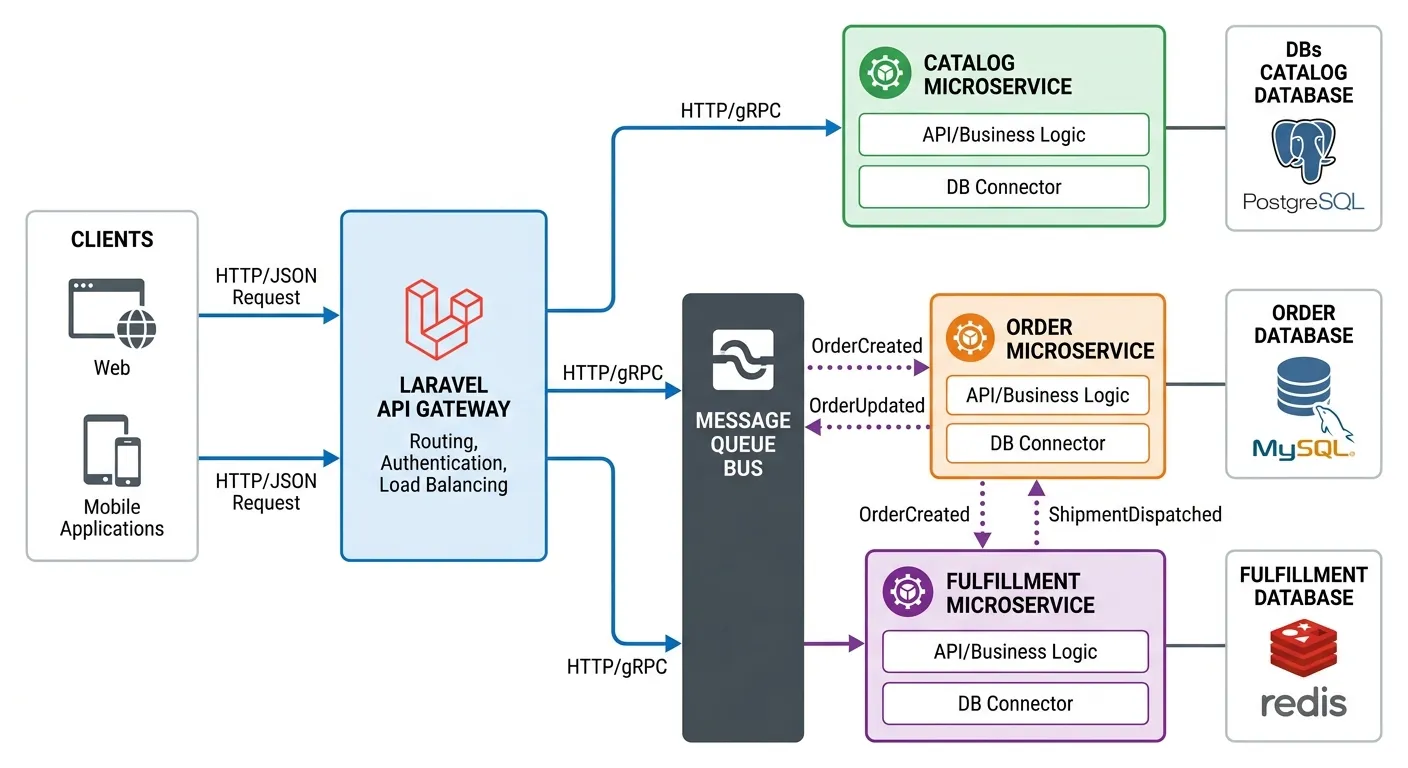
- Laravel as an API Gateway: A lightweight Laravel instance can act as the public-facing gateway, handling authentication, routing requests to internal services, and aggregating responses.
- Standalone Service Applications: Each core business capability is a separate Laravel (or Lumen) application with its own database, logic, and deployment pipeline.
- Shared Laravel Packages: Common code, like DTOs (Data Transfer Objects) or authentication logic, is packaged as private Composer repositories and shared across services to ensure consistency.
Communication between these services is critical. While RESTful APIs are common, leveraging message brokers like RabbitMQ or Redis Pub/Sub with Laravel's queue system enables robust, asynchronous event-driven communication, ideal for real-time inventory updates or notification fan-out.
Case Study: Scaling an E-commerce Platform
A fast-growing online retailer started with a monolithic Laravel app. During peak sales, the entire application would slow down due to a surge in inventory checks and payment processing.
The Solution: They decomposed the monolith into three core Laravel microservices:
- Catalog Service: Handled product listings, search, and caching. Scaled independently during browsing peaks.
- Order Service: Managed the shopping cart, checkout, and payment integration (using Laravel Cashier). Isolated from browsing traffic.
- Fulfillment Service: Processed orders, updated inventory via queued jobs, and communicated with warehouse APIs.
A primary Laravel gateway handled user sessions and routed requests. The result was a 70% reduction in page load times during flash sales and the ability to deploy updates to the order service without taking the entire site offline.
Implementing Resilience & Observability
Distributed systems introduce complexity. A resilient Laravel backend must handle service failures gracefully.
Circuit Breakers
Implement patterns like the Circuit Breaker (using packages like"laravel-circuit-breaker") for calls to external APIs or internal services. If a service fails repeatedly, the circuit"opens," failing fast and preventing cascading failures, and periodically probes to see if the service is healthy again.
Centralized Logging & Tracing
Use tools like Laravel Telescope (for monoliths) or integrate with ELK Stack (Elasticsearch, Logstash, Kibana) and distributed tracing systems like Jaeger or Zipkin. Correlate logs from all services with a unique request ID to track a user's journey across the entire system for debugging.
Health Checks & Metrics
Every Laravel service should expose a /health endpoint reporting database connectivity, cache status, and queue health. Aggregate metrics (request rates, error rates, latency) to a dashboard like Grafana with Prometheus. This proactive monitoring is vital for SLA compliance.
Professional Tooling & DevOps for Laravel
Building a robust backend extends beyond writing application code. A professional Laravel setup involves a sophisticated toolchain for development, testing, deployment, and maintenance.
The Modern Laravel Development Workflow
Local Environment with Docker
Gone are the days of wrestling with local PHP/MySQL configurations. Laravel Sail provides a Docker-powered development environment out of the box, ensuring every developer has an identical, isolated setup. This eliminates"it works on my machine" issues and mirrors production closely.
./vendor/bin/sail up
# Run tests, artisan commands, composer within containers
./vendor/bin/sail artisan migrate
./vendor/bin/sail composer require laravel/sanctum
Continuous Integration & Deployment (CI/CD)
Automating the path from code commit to production is essential for quality and agility. A typical Laravel CI/CD pipeline includes:
- Automated Testing: On every pull request, run PHPUnit for feature/unit tests, Pest for a more expressive syntax, and Laravel Dusk for browser testing.
- Static Analysis: Integrate tools like PHPStan or Laravel Pint (for code style) to catch bugs before runtime and enforce code quality standards.
- Security Scanning: Use Laravel Shift for automated upgrades and Enlightn for security and performance scanning of your codebase.
- Automated Deployment: Tools like Envoyer (for zero-downtime PHP deployments) or GitHub Actions workflows that run tests, build assets, and deploy to your servers or platforms like Laravel Vapor (serverless) or Forge-managed servers.
This automated safety net allows teams to deploy with confidence multiple times a day, a key tenet of modern DevOps.
Monitoring & Alerting in Production
Once live, your Laravel backend needs constant vigilance. Beyond basic error tracking (like Sentry or Bugsnag), monitor:
- Application Performance Monitoring (APM): Tools like Laravel Telescope (for development) or DataDog APM/New Relic (for production) provide deep insights into slow database queries, memory leaks, and request waterfalls.
- Business Metrics: Instrument your code to track key business events (e.g.,"purchase_completed") using Laravel's event system, sending them to analytics platforms. This ties backend performance directly to revenue.
- Infrastructure Health: Monitor server CPU/memory, queue lengths, database connection pools, and cache hit rates. Set up alerts for when metrics breach thresholds to proactively address issues before users are affected.
A well-instrumented Laravel application turns performance data into actionable intelligence, guiding optimization efforts and ensuring reliability.