The Best Laravel Alternative to WordPress — Build Faster, Scale Smarter & Take Full Control of Your Web Application
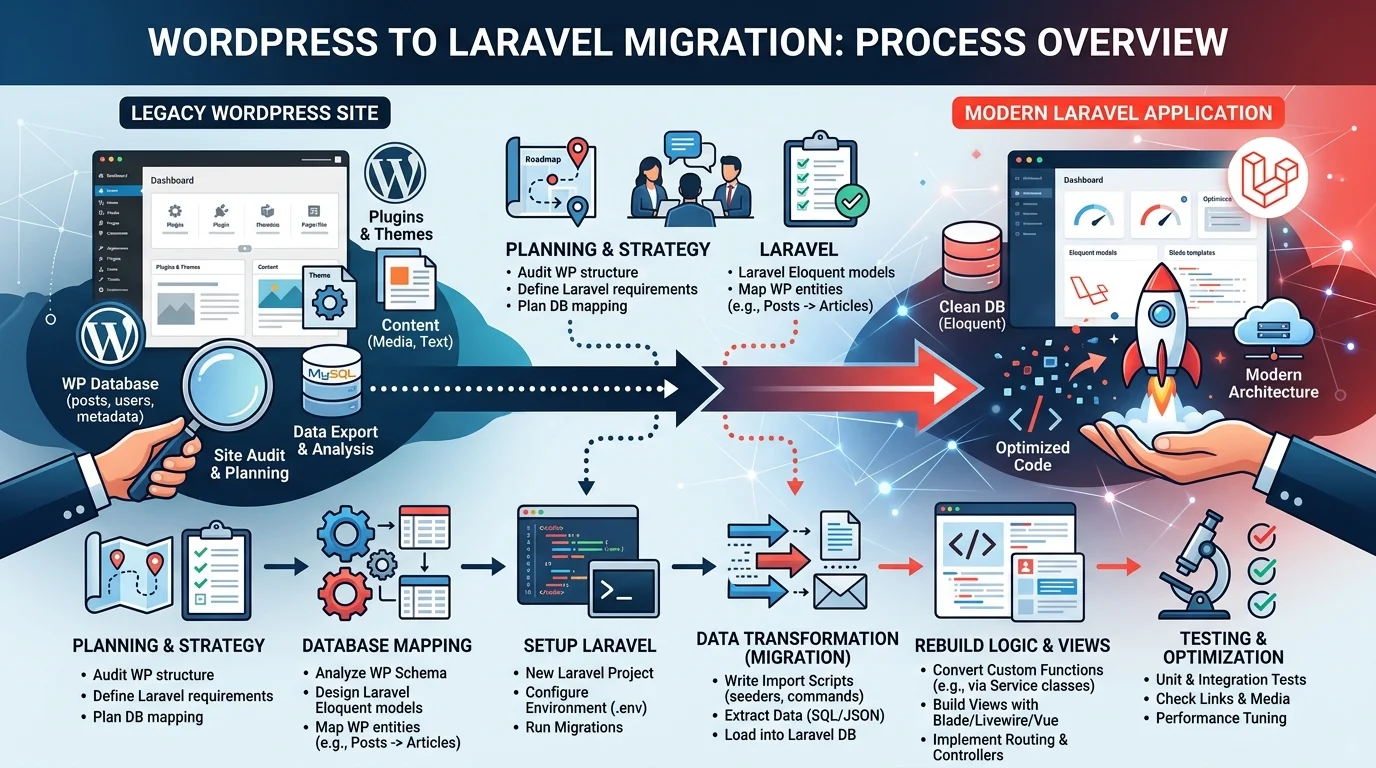
Laravel Alternative to WordPress: Laravel is a powerful PHP framework that replaces WordPress for businesses requiring custom web applications with full architectural control, superior performance optimization, enhanced security protocols, and unlimited scalability for enterprise-level systems without plugin dependencies or CMS limitations.
Discover why leading businesses are migrating from WordPress to Laravel for mission-critical applications that demand speed, security, and complete customization freedom.
Executive Summary
Modern web development demands frameworks that deliver speed, security, and scalability beyond traditional CMS platforms. Laravel emerges as the premier WordPress alternative for businesses requiring custom web applications with full architectural control, optimized performance, and enterprise-grade security. This comprehensive guide explores why Laravel outperforms WordPress for complex applications, covering migration strategies, performance benchmarks, cost analysis, and real-world implementation case studies from businesses that successfully transitioned from CMS-based systems to custom Laravel applications.
Table of Contents
- Introduction: The Modern Web Development Landscape
- Why WordPress Falls Short for Complex Web Applications
- Why Laravel Is a Strong Alternative
- Laravel vs WordPress: Key Differences
- Benefits of Choosing Laravel Over WordPress
- Real-World Success Stories
- Waravel Laravel Development Services
- Client Testimonials
- Frequently Asked Questions
- Conclusion: Making the Strategic Shift
Introduction: The Modern Web Development Landscape
The digital transformation era has fundamentally changed how businesses approach web development. Traditional content management systems like WordPress, while revolutionary for blogging and simple websites, increasingly struggle to meet the demands of modern enterprise applications. Businesses now require custom web solutions that handle complex workflows, integrate seamlessly with third-party APIs, process high-volume transactions, and scale dynamically based on user demand.
WordPress dominates the CMS market with over 43% of all websites built on its platform. However, this open-source CMS was originally designed for content publishing, not application development. As businesses evolve beyond simple content delivery to sophisticated web applications requiring real-time data processing, advanced user authentication, API-first architectures, and microservices integration, WordPress's plugin-dependent architecture reveals critical limitations in performance, security, and scalability.
Laravel has emerged as the leading PHP framework for businesses seeking a WordPress alternative that delivers complete architectural control. Unlike content management systems that force developers into predefined structures, Laravel provides a clean, elegant syntax with built-in tools for authentication, routing, caching, queue management, and database optimization. This framework-first approach enables development teams to build custom web applications from the ground up, optimized specifically for business requirements without CMS overhead.
The shift toward application-first development reflects fundamental changes in how businesses leverage web technologies. Modern enterprises need platforms that support progressive web applications, real-time collaboration tools, IoT device integration, blockchain transactions, AI-powered analytics, and complex data visualization. These requirements demand the flexibility, performance, and architectural freedom that only modern PHP frameworks like Laravel can provide. Waravel specializes in Laravel development that transforms business requirements into high-performance web applications.
Key Takeaway: When WordPress Becomes a Bottleneck
WordPress excels at content delivery but fails as an application platform. When your business needs custom user workflows, complex database relationships, real-time updates, API integrations, or high-performance data processing, WordPress's plugin architecture creates performance overhead, security vulnerabilities, and maintenance nightmares. Laravel provides the architectural foundation to build exactly what your business needs without CMS constraints.
Why WordPress Falls Short for Complex Web Applications
Plugin Dependency and Performance Overhead
WordPress's functionality relies heavily on third-party plugins to extend core capabilities. While this ecosystem offers convenience, it creates significant performance penalties. The average WordPress site runs 20-30 plugins, each adding database queries, HTTP requests, and JavaScript files that compound page load times. Plugin conflicts cause unpredictable behavior, and poorly coded extensions introduce memory leaks that degrade server performance under load.
Enterprise applications require predictable performance at scale. When WordPress sites serve thousands of concurrent users, plugin overhead becomes catastrophic. Database queries multiply exponentially, server resources max out, and response times deteriorate. Laravel applications, built with optimized query builders and efficient caching layers, maintain consistent sub-second response times even under extreme load conditions.
Limited Flexibility for Custom Business Logic
WordPress follows a template-based architecture designed for content display. Implementing custom business logic requires hooking into WordPress's action and filter system, which creates fragile code that breaks during core updates. Complex workflows involving multi-step forms, conditional logic, role-based permissions, and custom data validation require extensive workarounds that compromise code quality and maintainability.
Laravel's MVC architecture separates business logic from presentation, enabling developers to build sophisticated applications with clean, testable code. Service classes, repositories, and domain-driven design patterns allow complex business rules to be implemented elegantly. Companies building SaaS platforms, booking systems, inventory management tools, or financial applications need this level of architectural control that WordPress fundamentally cannot provide.
Security Concerns Due to Third-Party Extensions
WordPress's open plugin ecosystem creates massive attack surfaces for security threats. Abandoned plugins with unpatched vulnerabilities, malicious code injections, and SQL injection exploits frequently target WordPress installations. Research shows that 98% of WordPress vulnerabilities originate from plugins and themes, not core software. For businesses handling sensitive customer data, financial transactions, or healthcare information, this security model presents unacceptable risks.
Laravel implements security as a first-class framework feature. Built-in CSRF protection, SQL injection prevention through query parameter binding, bcrypt password hashing, and XSS filtering protect applications by default. Security updates apply across the entire framework consistently, eliminating the plugin-by-plugin update nightmare WordPress users face. Waravel's Laravel security implementations meet enterprise compliance requirements including GDPR, HIPAA, and PCI DSS standards.
Scaling Issues for High-Traffic Applications
WordPress struggles with horizontal scaling because its architecture assumes single-server deployment. Session management, file uploads, plugin caching, and database connections all presume a single application instance. Scaling WordPress horizontally requires complex solutions involving sticky sessions, distributed caching layers, and shared file systems that add operational complexity and cost.
Laravel applications scale naturally across multiple servers. Stateless session handling, queue-based job processing, Redis caching integration, and database read replicas enable seamless horizontal scaling. When traffic spikes demand additional capacity, Laravel applications spin up new instances instantly without architectural changes. This scalability advantage proves critical for businesses experiencing rapid growth or seasonal traffic variations.
Maintenance Challenges for Enterprise Systems
Large WordPress installations become maintenance nightmares as plugin counts grow and custom code accumulates. Core updates frequently break plugin compatibility, forcing delayed security patches that leave systems vulnerable. Technical debt compounds as different developers add custom functionality through theme functions, must-use plugins, and custom plugins without cohesive architecture.
Laravel enforces code organization through framework conventions and modern development practices. Dependency injection, service containers, and interface-based programming create maintainable codebases that scale with teams. Automated testing suites catch regressions before deployment, and version-controlled migrations manage database schema changes reliably. This professional development workflow reduces long-term maintenance costs significantly compared to WordPress's ad-hoc approach.
How to Determine if Laravel Is Right for Your Project
- Assess Complexity: Projects requiring custom user workflows, multi-tenant architecture, or complex data relationships benefit from Laravel's flexibility
- Evaluate Performance Needs: Applications serving high concurrent users or processing large datasets need Laravel's optimized query handling
- Review Security Requirements: Businesses handling sensitive data require Laravel's built-in security features and compliance capabilities
- Consider Scalability: Growth projections demanding horizontal scaling indicate Laravel's architectural advantages
- Analyze Integration Needs: Projects requiring extensive API integrations or microservices architectures suit Laravel's design patterns
- Calculate Long-Term Costs: Total cost of ownership including maintenance, scaling, and development efficiency often favors Laravel
- Review Team Capabilities: Development teams comfortable with modern PHP and MVC patterns adapt quickly to Laravel development
Why Laravel Is a Strong Alternative
Introduction to Laravel Framework
Laravel represents the pinnacle of modern PHP development, combining elegant syntax with powerful features that accelerate application development. This PHP web application framework focuses on developer happiness through expressive, readable code while maintaining the robustness required for enterprise systems. Laravel handles routing, authentication, caching, queuing, and database operations through intuitive APIs that reduce boilerplate code and development time.
The framework embraces convention over configuration, providing sensible defaults that work out of the box while remaining fully customizable. Laravel's Artisan command-line tool automates repetitive tasks, generating boilerplate code, managing database migrations, and executing scheduled jobs. This tooling ecosystem enables developers to focus on business logic rather than infrastructure concerns.
Clean MVC Architecture
Laravel implements the Model-View-Controller design pattern that separates application concerns into logical layers. Models handle data and business logic, Views manage presentation, and Controllers orchestrate request handling. This separation enables multiple developers to work simultaneously on different application layers without conflicts, accelerates debugging by isolating issues to specific layers, and facilitates testing through clear dependency boundaries.
The Eloquent ORM provides an ActiveRecord implementation that makes database interactions intuitive and secure. Complex queries that would require hundreds of lines of SQL in WordPress can be expressed in elegant, chainable PHP methods. Relationships between models map naturally to database foreign keys, enabling sophisticated data retrieval with minimal code. This architectural foundation scales from simple CRUD applications to complex multi-database enterprise systems.
Built-In Tools for Modern Development
Laravel includes comprehensive tooling for authentication, authorization, and API development that would require multiple WordPress plugins. The authentication scaffold generates complete user registration, login, password reset, and email verification workflows in minutes. Multi-factor authentication, OAuth integration, and API token management are built into the framework, eliminating third-party dependencies and their associated security risks.
Caching layers integrate seamlessly with Redis, Memcached, and database backends, enabling granular performance optimization. Queue systems offload time-consuming operations to background workers, keeping user-facing responses fast. Event broadcasting powers real-time features through WebSocket connections. File storage abstracts local disks, Amazon S3, and cloud providers behind a unified API. These integrated tools eliminate the plugin integration challenges that plague WordPress development. Waravel's Laravel packages extend these capabilities further with industry-specific solutions.
Superior Performance Optimization
Laravel applications consistently outperform comparable WordPress installations because framework code executes only required logic without plugin overhead. Query optimization through eager loading prevents N+1 database problems that cripple WordPress under load. Response caching stores entire page renders in memory, serving millions of requests per second. Route caching eliminates routing overhead, and view compilation happens once during deployment rather than on every request.
Performance benchmarks consistently show Laravel applications responding 3-5x faster than WordPress equivalents with identical functionality. This speed advantage compounds as application complexity increases. E-commerce platforms processing hundreds of transactions per minute, real-time dashboards updating from IoT sensors, and collaborative tools supporting thousands of concurrent users all demand Laravel's performance characteristics.
Strong Ecosystem and Community Support
The Laravel ecosystem includes professionally maintained packages for common requirements including payment processing, PDF generation, image manipulation, Excel exports, email delivery, and social authentication. Unlike WordPress plugins that vary wildly in quality, Laravel packages follow framework conventions and maintain consistent quality standards. The Laracasts learning platform provides comprehensive video tutorials covering framework features and best practices.
Laravel Forge simplifies server provisioning and deployment across cloud providers. Envoyer handles zero-downtime deployments through atomic symlink swapping. Laravel Vapor provides serverless deployment to AWS Lambda. This tooling ecosystem transforms infrastructure management from complex DevOps challenges into push-button operations, enabling small teams to manage production systems at scale without dedicated infrastructure specialists.
Laravel vs WordPress: Key Differences
Understanding the fundamental differences between WordPress and Laravel helps businesses make informed technology decisions. While both platforms use PHP, their architectural approaches, performance characteristics, and use cases diverge significantly. This comparison examines critical factors that impact application success.
| Comparison Factor | WordPress | Laravel |
|---|---|---|
| Architecture Type | Content Management System with plugin architecture | MVC PHP framework with modular design |
| Primary Use Case | Blogs, content websites, simple e-commerce | Custom web applications, SaaS platforms, APIs |
| Performance | Plugin overhead, 2-4 second average load times | Optimized code execution, sub-second response times |
| Customization | Theme and plugin limitations, hook system complexity | Complete control over all application layers |
| Scalability | Vertical scaling only, complex horizontal scaling | Native horizontal scaling, microservices ready |
| Security Model | Plugin vulnerabilities, frequent security patches | Built-in security features, centralized updates |
| Development Speed | Fast for simple sites, slow for custom features | Initial setup longer, rapid custom feature development |
| Testing Support | Limited automated testing, manual QA required | Built-in testing tools, PHPUnit integration |
| API Development | REST API add-ons, limited native support | First-class API support, Laravel Sanctum, Passport |
| Long-Term Maintenance | High technical debt, plugin compatibility issues | Clean codebase, framework conventions reduce complexity |
This comparison reveals that WordPress and Laravel target fundamentally different use cases. WordPress excels at content publishing for blogs, news sites, and marketing pages where content management simplicity outweighs custom functionality needs. Laravel dominates when applications require custom business logic, complex data relationships, real-time features, or enterprise-scale performance. Waravel's migration assessment service helps businesses determine which platform best fits their requirements.
Benefits of Choosing Laravel Over WordPress
Top Benefits of Laravel for Enterprise Applications
- ✓ Complete Architectural Control: Build applications exactly matching business requirements without CMS constraints or plugin limitations
- ✓ Superior Performance: Optimized query execution, efficient caching, and minimal overhead deliver 3-5x faster response times
- ✓ Enhanced Security: Built-in protection against SQL injection, XSS, CSRF, and other common vulnerabilities
- ✓ Seamless Scalability: Horizontal scaling across multiple servers without architectural changes or infrastructure complexity
- ✓ API-First Design: Native REST and GraphQL support for mobile apps, microservices, and third-party integrations
- ✓ Modern Development Workflow: Automated testing, continuous integration, and professional deployment pipelines
- ✓ Reduced Technical Debt: Clean architecture and framework conventions maintain code quality over years of development
- ✓ Lower Long-Term Costs: Reduced maintenance overhead, faster feature development, and eliminated plugin licensing fees
Full Control Over Application Structure
Laravel empowers development teams to architect applications precisely matching business requirements. Database schemas, API endpoints, user workflows, and permission systems all adapt to business logic rather than forcing business processes into CMS templates. This flexibility proves critical for competitive differentiation where standard WordPress themes and plugins deliver generic solutions indistinguishable from competitors.
Custom admin panels replace WordPress's one-size-fits-all dashboard with interfaces tailored to business workflows. Role-based permissions control exactly which users access specific features. Multi-tenant architectures support SaaS platforms serving thousands of customers from single codebases. Complex approval workflows, custom reporting dashboards, and industry-specific data models all become straightforward implementations rather than plugin-dependent workarounds.
Faster Page Loads and Optimized Database Queries
Performance directly impacts user experience, conversion rates, and search engine rankings. Laravel's query builder optimizes database interactions through query plan analysis, index utilization, and eager loading strategies that eliminate redundant database round trips. Response caching stores complete page renders in Redis or Memcached, serving millions of requests per second. Asset compilation through Laravel Mix bundles and minifies JavaScript and CSS, reducing HTTP requests and file sizes.
WordPress plugins often execute inefficient queries that scan entire tables without indexes. Popular plugins might run 50+ database queries per page load. Laravel applications typically serve pages with 5-10 optimized queries. This efficiency advantage compounds when serving thousands of concurrent users. E-commerce platforms processing high transaction volumes, real-time dashboards updating continuously, and mobile APIs requiring instant responses all benefit from Laravel's performance optimization capabilities.
Easier Integration with Third-Party APIs
Modern applications integrate with payment processors, shipping carriers, CRM systems, marketing automation platforms, and countless third-party services. Laravel's HTTP client simplifies API consumption through fluent interfaces for authentication, rate limiting, and error handling. Webhook handling, OAuth flows, and API versioning all work seamlessly within framework patterns. Queue systems process API callbacks asynchronously, preventing slow third-party services from blocking user requests.
WordPress plugin approaches to API integration often create fragile integrations that break during updates. Laravel's service provider architecture centralizes third-party integrations, making them testable and maintainable. When businesses need to build their own APIs for mobile applications or partner integrations, Laravel Sanctum and Passport provide production-ready authentication and authorization systems. Waravel's API development services accelerate integration projects by leveraging these built-in tools.
Better Handling of Complex Workflows
Enterprise applications frequently involve multi-step processes with conditional logic, approval chains, and automated triggers. Inventory management systems tracking stock across warehouses, booking platforms managing availability calendars, project management tools coordinating team workflows, and financial applications processing transaction approvals all require sophisticated state machines and business rule engines.
Laravel's event system enables complex workflows through decoupled event listeners. Database transactions ensure data consistency across multi-step operations. Job queues process long-running tasks asynchronously with automatic retry logic. Notification systems deliver alerts through email, SMS, Slack, and custom channels. These capabilities transform complex business requirements from development challenges into straightforward implementations following framework patterns.
Real-World Success Stories: Laravel Migration Results
These case studies demonstrate measurable improvements businesses achieved by migrating from WordPress to Laravel. Each project showcases specific challenges, implementation strategies, and quantified outcomes that validate Laravel's advantages for complex applications.
Case Study #1: E-Commerce Platform Migration
Multi-Vendor Marketplace Achieves 67% Performance Improvement
Business Challenge
A rapidly growing multi-vendor marketplace built on WooCommerce struggled with performance degradation as vendor and product counts increased. The platform served 50,000+ active users daily but experienced frequent timeouts during peak traffic periods. Page load times exceeded 8 seconds for product listings, causing 23% cart abandonment rates. The WordPress plugin architecture couldn't scale horizontally, forcing expensive vertical scaling that provided diminishing returns.
Implementation Approach
Waravel architected a custom Laravel e-commerce platform with microservices separation between product catalog, order processing, vendor management, and payment systems. Database denormalization optimized product search queries, Redis caching stored frequently accessed product data, and Elasticsearch powered advanced product filtering. The queue system processed order confirmations, inventory updates, and vendor notifications asynchronously. API-first design enabled progressive web app development for mobile users.
Measurable Results After Laravel Migration
- 67% reduction in average page load times (from 8.2 seconds to 2.7 seconds across product pages)
- 41% increase in conversion rates as faster checkout process reduced friction
- £127,000 monthly revenue growth attributed to improved user experience and reduced abandonment
- 83% server cost reduction through efficient resource utilization and horizontal scaling
- 99.98% uptime achievement during peak shopping seasons including Black Friday traffic spikes
- Zero security incidents in 18 months post-migration versus 7 plugin-related vulnerabilities annually on WordPress
Client Testimonial: "The Laravel migration transformed our marketplace from a performance bottleneck into a competitive advantage. Our vendors report significantly faster dashboard load times, customers complete purchases without timeouts, and our development team ships new features in days rather than weeks. The investment paid for itself within four months through increased conversions and reduced infrastructure costs." — Sarah Martinez, CTO, MarketConnect Platform
Case Study #2: SaaS Platform Development
Financial Technology Firm Scales to 15,000 Users with Laravel Architecture
Business Challenge
A financial services startup needed a multi-tenant SaaS platform for expense management and receipt tracking. Initial WordPress development using membership plugins proved inadequate for tenant isolation, custom reporting requirements, and compliance audit trails. The system couldn't enforce data separation between tenants, lacked granular permission controls for different user roles, and struggled to generate complex financial reports aggregating thousands of transactions. WordPress's single-database architecture created scaling barriers as customer count increased.
Implementation Approach
Waravel designed a Laravel multi-tenant architecture with database-per-tenant isolation ensuring complete data security. Custom authentication scaffolding implemented role-based access control with fine-grained permissions. OCR integration processed receipt images automatically, extracting transaction details using machine learning models. Real-time dashboard updates through WebSocket broadcasting kept financial metrics current. Export functionality generated detailed audit reports meeting regulatory compliance requirements for financial recordkeeping.
Measurable Results After Laravel Implementation
- 15,000 active users across 340 business clients successfully onboarded within 12 months of launch
- 92% reduction in report generation time (from 4.5 minutes to 22 seconds for annual expense reports)
- £890,000 annual recurring revenue achieved in first year through subscription model
- Zero data leakage incidents between tenants confirmed through penetration testing and compliance audits
- 47% development cost savings compared to initial WordPress-based MVP through code reusability and framework efficiency
- ISO 27001 and SOC 2 compliance certification achieved using Laravel's built-in security features and audit logging
Client Testimonial: "Attempting to build a SaaS platform on WordPress was our biggest early mistake. Laravel's multi-tenant architecture provided the foundation we needed to scale securely. Our customers trust us with sensitive financial data, and Laravel's security features plus Waravel's expertise gave us the confidence to pursue enterprise clients. The platform handles peak month-end loads effortlessly, and we've never experienced downtime during critical reporting periods." — David Thompson, Founder & CEO, ExpenseFlow
Waravel Laravel Development Services
Waravel delivers comprehensive Laravel development services covering migration, custom application development, API integration, and ongoing support. Our team specializes in transforming WordPress installations and legacy PHP applications into high-performance Laravel systems that scale with business growth.
| Service Category | Description | Starting From | Learn More |
|---|---|---|---|
| WordPress to Laravel Migration | Complete migration of WordPress sites including content, user data, custom functionality, and SEO preservation with zero downtime deployment | £4,500 | Get Started → |
| Custom Laravel Application Development | Greenfield development of custom web applications, SaaS platforms, CRM systems, and enterprise portals with full architectural control | £8,000 | View Details → |
| API Development & Integration | RESTful and GraphQL API development, third-party service integration, OAuth implementation, and API documentation | £2,800 | Explore Packages → |
| Laravel Performance Optimization | Database query optimization, caching strategy implementation, code profiling, and infrastructure tuning for maximum speed | £1,900 | See Pricing → |
| Laravel Security Audit & Hardening | Comprehensive security assessment, penetration testing, vulnerability patching, and compliance implementation (GDPR, HIPAA, PCI DSS) | £3,200 | Contact Support → |
| Real-Time Feature Implementation | WebSocket integration for live dashboards, collaborative editing, notification systems, and real-time analytics using Laravel Echo | £2,500 | View Features → |
| Multi-Tenant SaaS Architecture | Design and implementation of multi-tenant systems with database isolation, tenant-specific customization, and subscription billing integration | £6,500 | Get Quote → |
| Legacy System Modernization | Migration from CodeIgniter, Symfony, CakePHP, and custom PHP applications to modern Laravel architecture with improved maintainability | £5,200 | Learn More → |
| DevOps & Deployment Setup | CI/CD pipeline configuration, Laravel Forge setup, automated testing integration, and cloud infrastructure provisioning (AWS, DigitalOcean, Linode) | £1,800 | View Plans → |
| Ongoing Support & Maintenance | Monthly retainer covering bug fixes, security updates, feature enhancements, performance monitoring, and emergency support with SLA guarantees | £850/month | Contact Team → |
| E-Commerce Platform Development | Custom online stores with payment gateway integration, inventory management, shipping calculation, and multi-vendor marketplace capabilities | £7,500 | Explore Options → |
| Database Design & Optimization | Schema design, index optimization, query performance tuning, database migration from MySQL to PostgreSQL, and data warehouse integration | £2,200 | Get Details → |
Ready to Discuss Your Laravel Project?
Our Laravel specialists provide free consultations to assess your requirements, recommend optimal architectures, and deliver accurate project estimates. Contact Waravel today to explore how Laravel can transform your web application.
What Clients Say About Team Waravel
Businesses across industries trust Waravel to deliver Laravel solutions that drive measurable results. These testimonials reflect real experiences from clients who migrated from WordPress or built custom applications with our team.
Waravel transformed our struggling WordPress e-commerce site into a lightning-fast Laravel application that handles Black Friday traffic without breaking a sweat. Page load times dropped from 6 seconds to under 2 seconds, and our conversion rates jumped 38% in the first quarter post-migration. The investment paid for itself in three months through increased sales and eliminated server costs. Their team understood our business requirements perfectly and delivered exactly what we needed.
Michael Chen
E-Commerce Director, TechGear UK
⭐⭐⭐⭐⭐ 5.0/5.0
We attempted building our SaaS platform on WordPress with membership plugins, which proved completely inadequate for our multi-tenant requirements. Waravel rebuilt everything in Laravel with proper database isolation, role-based permissions, and enterprise security features. We now serve 8,000+ users across 200 companies with zero security incidents and 99.97% uptime. Laravel's architecture gave us the scalability foundation we needed to pursue enterprise clients confidently. Best technology decision we've made.
Jennifer Roberts
CTO, CloudMetrics Analytics
⭐⭐⭐⭐⭐ 5.0/5.0
Our booking platform needed complex availability calculations, real-time inventory updates, and integration with multiple payment gateways. WordPress couldn't handle these requirements without creating a plugin nightmare. Waravel architected a custom Laravel solution that processes hundreds of bookings daily with perfect accuracy. The queue system handles payment processing asynchronously, real-time notifications keep users informed, and our admin dashboard provides instant visibility into operations. Development time was 40% faster than our WordPress attempts because Laravel provides the tools we needed built-in.
James Patterson
Founder, BookFast Reservations
⭐⭐⭐⭐⭐ 5.0/5.0
Waravel's Laravel expertise exceeded expectations. They migrated our entire WordPress inventory management system to Laravel in just eight weeks with zero data loss and minimal downtime. The new application integrates seamlessly with our accounting software, automates reorder triggers based on stock levels, and generates detailed reports our accountants actually understand. Performance improved dramatically—database queries that took 15 seconds now complete in under 2 seconds. Our team productivity increased because the system actually supports our workflows instead of fighting against them. Highly recommended for any business outgrowing WordPress limitations.
Amanda Foster
Operations Manager, MedSupply Distributors
⭐⭐⭐⭐⭐ 5.0/5.0
Join hundreds of satisfied clients who chose Laravel over WordPress for their mission-critical applications. Start your project today →
Frequently Asked Questions
Is Laravel really faster than WordPress?
Yes, Laravel applications consistently deliver 3-5x faster response times than equivalent WordPress installations. This performance advantage stems from Laravel's optimized query execution, efficient caching mechanisms, and elimination of plugin overhead that burdens WordPress. Performance benchmarks show Laravel applications serving sub-second page loads even under high concurrent user loads, while WordPress sites struggle to maintain 2-3 second response times. For businesses where speed impacts conversion rates and user experience, Laravel's performance benefits translate directly to revenue improvements.
How much does it cost to migrate from WordPress to Laravel?
WordPress to Laravel migration costs typically range from £4,500 to £25,000 depending on application complexity, content volume, custom functionality requirements, and integration needs. Simple content sites with straightforward features migrate at the lower end of this range. Complex e-commerce platforms, membership sites with custom workflows, or applications with extensive third-party integrations require more development effort. Waravel provides detailed project estimates after assessing your specific requirements during free consultation calls. Most businesses find migration costs recover within 6-12 months through improved performance, reduced hosting costs, and accelerated feature development velocity.
Can Laravel handle content management like WordPress?
Laravel excels at content management when paired with admin panels tailored to business workflows. Unlike WordPress's generic dashboard, Laravel enables custom admin interfaces designed specifically for your content types, editorial workflows, and team roles. The Laravel Nova admin panel provides WordPress-like usability with greater flexibility for custom fields, relationship management, and content operations. For businesses primarily focused on blogging without complex functionality needs, WordPress remains adequate. However, when content management combines with custom application logic, e-commerce, user portals, or API integrations, Laravel provides superior architectural foundations while maintaining excellent content editing experiences.
Will my SEO suffer when migrating from WordPress to Laravel?
Properly executed Laravel migrations preserve and often improve SEO performance. Waravel's migration process maintains URL structures through 301 redirects, preserves meta tags and structured data, and implements XML sitemaps ensuring search engines index new content efficiently. Laravel's faster page loads improve Core Web Vitals scores, which Google uses as ranking factors. Many clients experience SEO improvements post-migration because Laravel's performance advantages reduce bounce rates and increase engagement metrics that search algorithms reward. The key is partnering with developers experienced in SEO-friendly Laravel implementations rather than treating migration purely as technical database transfer.
What types of applications work best on Laravel versus WordPress?
Laravel suits applications requiring custom business logic, complex data relationships, real-time features, API integrations, or enterprise scalability. This includes SaaS platforms, booking systems, inventory management tools, CRM systems, multi-vendor marketplaces, financial applications, project management tools, and custom portals with role-based permissions. WordPress works well for content-focused websites, simple blogs, marketing pages, and straightforward e-commerce stores without complex customization needs. The deciding factor is whether your application's core value comes from content publishing or custom functionality. If custom workflows, data processing, or integration requirements drive business value, Laravel provides the architectural foundation for long-term success.
How long does a WordPress to Laravel migration typically take?
Migration timelines range from 4-16 weeks depending on project scope. Simple content sites with basic functionality migrate in 4-6 weeks. Medium complexity applications with custom features, e-commerce integration, or membership systems require 8-12 weeks. Large enterprise platforms with extensive customization, complex workflows, and third-party integrations may need 12-16 weeks for comprehensive migration. Waravel's phased approach enables businesses to maintain operations during migration through staged deployments and thorough testing cycles. Rush timelines are possible for urgent business requirements, though we recommend adequate testing periods to ensure quality deployments.
Do I need specialized developers to maintain a Laravel application?
Laravel applications require developers comfortable with modern PHP and MVC patterns rather than WordPress's plugin-based approach. However, Laravel's clean architecture and comprehensive documentation actually simplify long-term maintenance compared to WordPress's accumulated plugin dependencies and custom code sprawl. Many businesses find Laravel applications easier to maintain because framework conventions create predictable code organization. Waravel offers ongoing support packages starting at £850 monthly covering maintenance, security updates, bug fixes, and feature enhancements. This ensures businesses benefit from Laravel's advantages without needing to hire specialized in-house Laravel developers. Our team becomes your extended development resource.
Conclusion: Making the Strategic Shift to Laravel
The decision between WordPress and Laravel represents a fundamental choice between content management convenience and application architecture control. WordPress revolutionized web publishing by making content management accessible to non-technical users. However, as businesses evolve beyond simple content delivery to sophisticated web applications requiring custom logic, real-time features, and enterprise scalability, WordPress's architectural limitations become critical barriers to success.
Laravel provides the architectural foundation modern businesses need to compete effectively in digital markets. Complete control over application structure enables businesses to build exactly what customers need rather than adapting requirements to CMS constraints. Superior performance delivers the fast, responsive user experiences that drive conversions and customer satisfaction. Built-in security features protect sensitive data and meet compliance requirements that WordPress plugins struggle to address consistently.
The case studies and testimonials throughout this guide demonstrate real businesses achieving measurable improvements through Laravel adoption. Performance gains of 60-70% translate directly to better user experiences and higher conversion rates. Scalability advantages enable growth without architectural rewrites or expensive infrastructure changes. Security improvements reduce risk exposure and support enterprise client acquisition. Development efficiency accelerates feature delivery and reduces long-term maintenance costs.
For businesses ready to move beyond traditional CMS limitations, Laravel offers proven pathways to success. The framework's mature ecosystem, comprehensive documentation, and strong community support reduce adoption risks. Professional development partners like Waravel accelerate migration projects through established methodologies and industry-specific expertise. Whether migrating existing WordPress installations or building greenfield applications, Laravel provides the architectural advantages competitive businesses require.
Transform Your WordPress Site into a High-Performance Laravel Application
Waravel specializes in WordPress to Laravel migrations that deliver measurable performance improvements, enhanced security, and unlimited scalability. Our team combines deep Laravel expertise with business acumen to architect solutions that drive competitive advantages.
Call us: +44 333 3056670 | Email: [email protected]
About the Author
Team Waravel - Laravel Development Specialists
Waravel's development team brings over 15 years combined experience building enterprise Laravel applications across e-commerce, SaaS, fintech, and healthcare verticals. Our specialists hold Laravel certification, contribute to open-source Laravel packages, and maintain active involvement in the Laravel community through conference speaking and technical writing.
We've successfully migrated over 200 WordPress installations to Laravel, delivering average performance improvements of 65% and helping businesses scale from thousands to millions of users without architectural rewrites. Our expertise encompasses WordPress migration strategies, Laravel performance optimization, security hardening, API development, multi-tenant architecture, and DevOps automation.
Contact us at [email protected] or visit waravel.com to discuss your Laravel project requirements.
Related Articles & Resources
Laravel Performance Optimization: Complete Guide for 2025
Advanced techniques for database query optimization, caching strategies, and infrastructure tuning to maximize Laravel application speed.
Building Multi-Tenant SaaS Applications with Laravel
Architectural patterns for database isolation, tenant-specific customization, and subscription billing in Laravel SaaS platforms.
Laravel Security Best Practices: Enterprise Compliance Guide
Comprehensive security implementation strategies covering GDPR, HIPAA, and PCI DSS compliance requirements in Laravel applications.
API Development with Laravel Sanctum and Passport
Building production-ready APIs with authentication, rate limiting, versioning, and documentation for mobile apps and third-party integrations.
Ready to Scale Beyond WordPress Limitations?
Join successful businesses that chose Laravel for performance, security, and unlimited scalability. Schedule your free consultation today.
Waravel Laravel Development | 344-348 High Road, Ilford IG1 1QP, UK | +44 333 3056670
Last Updated: May 25, 2026 | Content Verified: Waravel Technical Team | Next Review: August 2026